Safety & eclipse modes

The rules that protect your eyes and your gear, and the one setting that decides when the filter comes off.

⚠ The absolute rules

1. Eye safety never changes with the imaging mode. Never look at the Sun with the naked eye, or through any finder, eyepiece or unfiltered optic, without certified eye protection, except during totality itself (the bright disc fully covered). For your eyes this conservative timing applies in both Safe and Diamond ring modes. Unfiltered sunlight through optics causes permanent, instant eye injury.

2. Keep a suitable solar filter secured over the front of every imaging scope through the partial phases. Unfiltered sunlight can damage a camera sensor. If you use a separate guide scope, filter it too. In shared camera mode there is only the main scope. When that scope filter comes off is set by the eclipse mode described below. This is an equipment and imaging decision, separate from the eye rule above.

3. For your eyes, the partial phases are never safe unfiltered, including the thin crescent, Baily's beads and the diamond ring. Even a sliver of the photosphere is blinding through optics. (In Diamond ring mode the scope's filter does come off at the diamond ring to image it, but that is the camera, not your eyes.)

4. Use purpose made solar filters only. The filter must be suitable for the instrument and secured over the front of the optics. Inspect it for pinholes or damage before every use. Never look through an instrument unless its front filter is specifically rated for visual solar use. Improvised filters, exposed film, photographic neutral density filters, or welding glass of unknown grade are not acceptable.

Diamond ring versus Safe mode

HelioMaker's eclipse plans for a total eclipse carry an eclipse mode setting with two radio buttons in Plan preferences: Safe (the default) and Diamond ring (Classical). It is the single most important choice in the plan: it changes when the scope's solar filter comes off and back on, how deep the exposure brackets go around second and third contact (C2/C3), and what the audio and visual cues say. You pick it in the plan editor; it is saved with the plan.
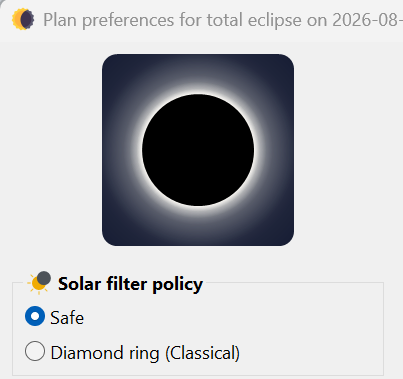
Solar filter policy in Plan preferences with Safe selected as the
  default and Diamond ring Classical available as the alternative.
Select Safe or Diamond ring (Classical) in Plan preferences. Safe is the default; the mode remains the user's decision and changes filter timing, phase recipes and cues.
This is about the equipment filter, not your eyes The mode sets when the scope's solar filter comes off. This is an equipment and imaging decision. Your own eye protection follows the conservative rule in both modes: it only comes off during totality itself. AAS imaging guidance informs Diamond ring mode, in which the scope's filter comes off at the diamond ring; it does not change when it is safe to look.
Default mode Safe mode is the default. It keeps the unfiltered window conservative: you are prompted to replace the filter early, while the solar disk is still covered, using the planned time rather than waiting for the light to return. You trade a few seconds at the very start and end of totality for a comfortable margin against getting caught unfiltered.
Totality filter margin in Safe mode Totality filter margin (s): exists to create a deliberate buffer between the predicted contact times and the physical filter changes. It places filter removal that many seconds after C2 and filter replacement the same number of seconds before C3. It does not alter the calculated C2 or C3 times. Instead, it shortens the unfiltered interval so that you wait until after the predicted start of totality before removing the filter and have time to replace it before the photosphere is predicted to return. A larger margin provides more allowance for contact timing uncertainty and filter handling, but leaves less time for unfiltered imaging. The timeline, cues and run monitor use those exact filter change instants. If you accept Safe mode recipe regeneration, the margin also influences the default C2 and C3 phase windows, with a small overlap past each filter transition; the Phase editor can tune those windows separately. The setting has no effect in Diamond ring (Classical) mode.

Safe (default)

  • Scope filter off: only once the disc is fully covered, with margin.
  • Scope filter on: prompted early, while totality is still in progress. This is a planned, conservative cue.
  • Shallower C2/C3 exposure brackets; cues worded for the conservative workflow.
  • Provides: a greater timing margin around the unfiltered interval.

Diamond ring (Classical)

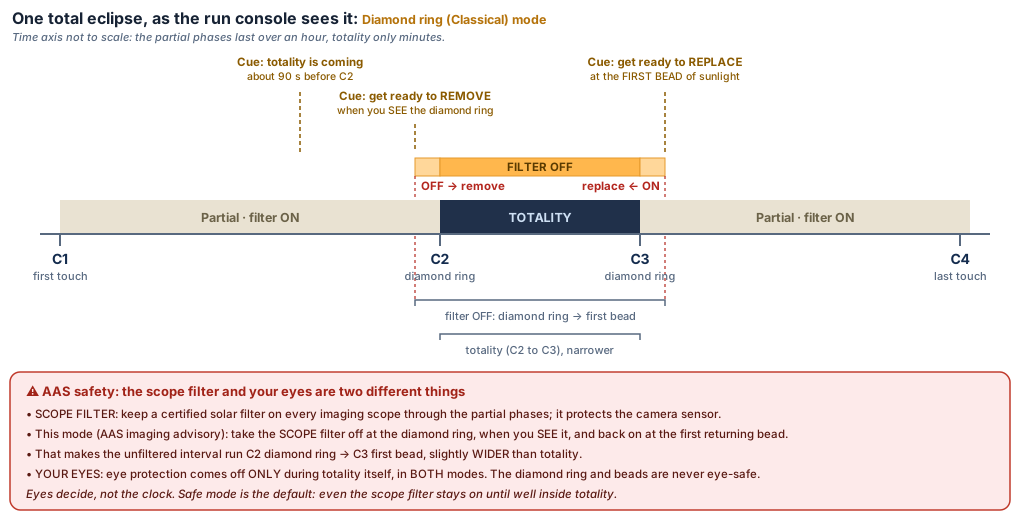
  • Scope filter off: at the C2 diamond ring. You remove it when you see the diamond ring and put it back on at the C3 diamond ring or first bead. This window is slightly wider than totality.
  • Scope filter on: at third contact, on the first returning bead, which is later than in Safe mode.
  • Deeper C2/C3 brackets to capture the inner corona and prominences.
  • Requires: an operator who understands the risk and has rehearsed the timing until it is automatic.

The two modes on a timeline

The eclipse and contacts are the same. The difference is when the filter comes off and back on, and what the cues say. Compare:
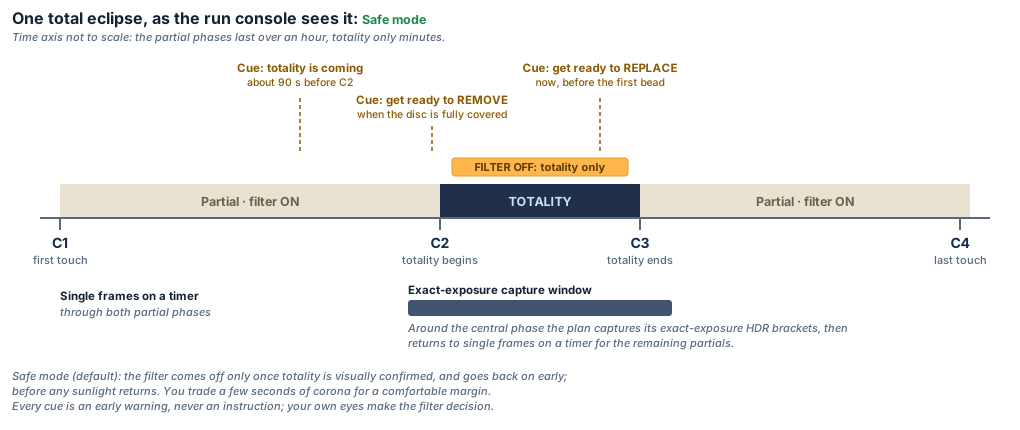
Safe mode total eclipse timeline: the unfiltered interval is inside totality; the remove cue fires when the disc is fully covered and the replace cue fires early, before the first bead.
Safe mode: conservative unfiltered interval; replace early, before the first bead.
Diamond ring (Classical) mode total eclipse timeline: the unfiltered interval runs from the C2 diamond ring to the C3 diamond ring; the remove cue fires when you see the diamond ring and the replace cue fires at the first returning bead.
Diamond ring (Classical): the unfiltered interval is wider than totality, from diamond ring to first bead. Visual confirmation controls both ends. Note the AAS safety panel.
Eyes, not the clock Whichever mode you use, HelioMaker's cues are deliberately tied to what you see, not blindly to a countdown. Remove the filter only when you actually see the diamond ring / totality. In Safe mode, replace it early, on the cue, while the disc is still dark. Never remove a filter because "the timer says so" if the Sun still looks bright. Trust your eyes and err toward keeping the filter on.

For partial and annular eclipses the mode is fixed to the safe behaviour (the filter never comes off), so the toggle is hidden. There is no total phase in which unfiltered viewing is ever appropriate.

Guiding through the filter change If your plan guides through the unfiltered phases (see Plan preferences and the preflight checklist), remember the guide scope has its own filter on its own schedule. HelioMaker warns about this at arm time and names both scopes' filters in the live cue. Decide in advance whether the guide scope stays filtered (guiding pauses through totality) or you accept the tradeoff. Do not improvise it at C2.

Authoritative safety references

Review the current guidance from NASA eclipse safety and AAS solar filters for optics before observing or imaging an eclipse. These sources explain direct viewing, front mounted instrument filters, and the special case of totality.